


By SCM Staff Writer I May 31, 2026
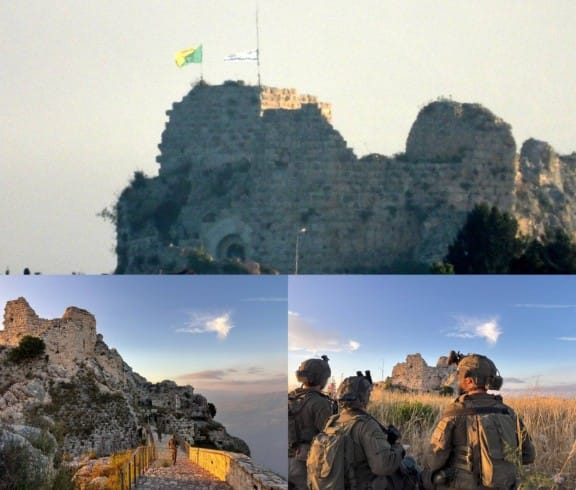
BEIRUT, Lebanon — Israeli ground forces have captured the historic Beaufort Castle and its commanding mountain ridge in southern Lebanon, the military announced Sunday.
The advance marks the deepest tactical incursion into Lebanese territory in more than a quarter-century and signals a major escalation as Israel openly expands its operations across the Litani River.
The capture of the 900-year-old Crusader-era fortress, known locally as Qalaat al-Shaqif, came after days of intense airstrikes, artillery duels, and close-quarters infantry fighting in the rugged villages surrounding the strongholds of Yohmor and Nabatiyeh.
Photographs released by the Israel Defense Forces (IDF) and verified by independent news agencies showed the blue-and-white flag of Israel alongside the yellow-and-black banner of the elite Golani Brigade flying from the uppermost stone ramparts of the medieval citadel.
The breakthrough represents a significant symbolic and military milestone, carrying deep historical echoes for both nations. Prime Minister Benjamin Netanyahu praised the troops in a video address, characterizing the operation as a “dramatic shift” in Israel’s campaign against the militant group Hezbollah.
”Today, we have returned to Beaufort,” Mr. Netanyahu said. “I instructed the IDF to expand the maneuver in Lebanon to deepen and expand our hold on areas that were under Hezbollah control. We have broken the barrier of fear.”
Perched atop a sheer rock face nearly 2,300 feet above the Litani River, Beaufort Castle has been prized by military strategists since the 12th century. The fortress commands sweeping, unobstructed views of the Galilee Panhandle in northern Israel to the south, and the western Bekaa Valley and the city of Nabatiyeh to the north.
For months, according to Israeli military officials, Hezbollah units utilized the natural caves, modern bunkers, and underground infrastructure built into the Beaufort Ridge to coordinate rocket and drone assaults against northern Israeli border towns.
”Whoever threatens the citizens of Israel will lose their strategic assets one after another,” Israel’s Defense Minister, Israel Katz, said in a statement celebrating the capture. Mr. Katz confirmed that he had authorized forces to breach the Litani River—long considered a de facto red line in Lebanese border conflicts—to seize the high ground.
Mr. Katz added that Israeli forces “will remain there as part of a security zone in Lebanon” to guarantee that communities in the Galilee panhandle are removed from the direct line of fire.
The military push has come at a steep human cost. Even as the fortress fell, the IDF announced that a Hezbollah explosive drone strike on Saturday had killed an Israeli soldier, Staff Sgt. Michael Tyukin, 21, and wounded four others. Meanwhile, inside Lebanon, the expanding ground offensive has triggered a fresh wave of displacement.
The IDF issued sweeping evacuation orders for dozens of towns and cities south of the Zahrani River, instructing residents of major urban centers like Nabatiyeh and the historic coastal city of Tyre to flee north immediately.
For a generation of Israelis and Lebanese, the return of Israeli boots to the stone floors of Beaufort Castle revives the ghosts of a long, bloody entanglement.
The citadel was last captured by Israel in June 1982 during the opening days of the First Lebanon War, in a fierce, costly assault led by the Golani Brigade.
For the next 18 years, the fortress served as the ultimate symbol of Israel’s controversial “security zone”—a heavily fortified hilltop outpost from which young conscripts faced relentless guerrilla attacks by a nascent Hezbollah.
The base became so synonymous with the grueling, claustrophobic nature of that conflict that it inspired award-winning Israeli literature and cinema, illustrating the deep domestic scars left by the occupation.
When Israel abruptly withdrew its forces from southern Lebanon in May 2000 under Prime Minister Ehud Barak, the abandonment of Beaufort was celebrated across the Arab world as a defining triumph for Hezbollah.
To right-wing members of the current Israeli governing coalition, Sunday’s capture was framed as a historical correction. Bezalel Smotrich, the far-right Finance Minister, wrote on social media that “the return to Beaufort is an expression of correcting old national sins and distorted perceptions,” promising residents of northern Israel that the military would maintain its positions this time to ensure lasting security.
The offensive on the Beaufort Ridge highlights the complete unraveling of a fragile, nominal ceasefire that had been brokered in mid-April following an intense spike in regional hostilities.
That truce had established a temporary demarcation line, colloquially known as the “Yellow Line,” which was intended to freeze active ground maneuvering.
However, diplomatic paralysis and stalled indirect negotiations between regional powers left a security vacuum. Military analysts suggest that Israeli planners chose to strike across the Litani River to dismantle Hezbollah’s heavy weapons infrastructure before international diplomatic pressure could lock a more permanent ceasefire into place.
By taking the high ground at Beaufort, Israeli forces have effectively positioned themselves to split southern Lebanon along its geographic axes, creating a platform to encircle Nabatiyeh, an economic and cultural heartland for the country’s Shiite population.
Lebanese authorities and international observers expressed immediate alarm over the escalation and the potential danger posed to ancient cultural heritage sites, which had previously been granted enhanced protection status by UNESCO.
In Beirut, government officials condemned the incursion as a blatant violation of national sovereignty, warning that the creation of a new, permanent Israeli “security zone” north of the border would only guarantee further decades of cyclical violence.