


By Emmanuel Thomas I Monday, July 06, 2026
SEATTLE — On the eve of the most consequential match of the United States men’s national soccer team’s modern era, the sport of football has found itself ensnared in a familiar, uncomfortable matrix of political lobbying, institutional elasticity, and administrative fury.
The catalyst is Folarin Balogun, the 25-year-old vanguard of the American attack whose three goals have propelled the World Cup co-hosts into the tournament’s knockout stages.
On Monday night, Balogun will walk onto the pitch at Seattle Stadium to face Belgium in the Round of 16—a reality that appeared legally impossible just 24 hours prior, and one that has prompted accusations of corruption from Brussels to Zurich.
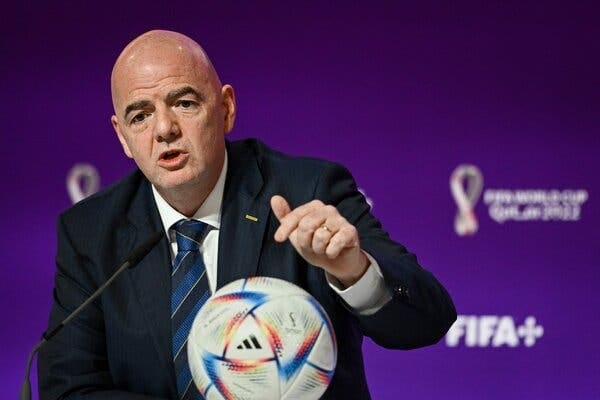
Breaking days of frantic silence, FIFA President Gianni Infantino moved on Monday to contain a mounting crisis that threatens to overshadow the tournament itself.
In an extraordinary public statement, Infantino confirmed that he had received a personal phone call from President Donald Trump advocating on the American striker’s behalf, but steadfastly defended the “independence” of the judicial bodies that ultimately cleared Balogun to play.
“I have seen the public comments regarding the decision of the independent FIFA Disciplinary Committee related to the suspension of Folarin Balogun, and I would like to reiterate a fundamental principle of FIFA’s governance,” Infantino said.
“FIFA’s judicial bodies are independent. They operate autonomously, apply the FIFA Disciplinary Code, and decide cases based on the applicable regulations and the specific facts before them.”
The controversy began during the United States’ 2-0 victory over Bosnia and Herzegovina in the Round of 32 last Thursday. Balogun, having already scored the opening goal, was sent off in the 64th minute following a VAR review that judged his challenge on Tarik Muharemović to be serious foul play.
By the letter of FIFA’s own law, a direct red card mandates an automatic, unappealable one-match ban.
Yet on Sunday morning, as the American squad boarded a bus from their downtown Seattle hotel to a training session at the University of Washington, players looked at their phones to find an administrative miracle. FIFA’s Disciplinary Committee had invoked Chapter 4, Article 27 of its code, enacting a “suspended suspension.”
Balogun’s ban would be deferred for a one-year probationary period; if he avoids another severe infraction, he will never serve it.
The legal precedent cited by insiders is the so-called “Ronaldo Rule,” used late last year to defer a violent conduct ban issued to Portuguese star Cristiano Ronaldo so he could participate in this very World Cup. But where Ronaldo’s case was viewed as bureaucratic leniency for an aging icon, Balogun’s reprieve carries the heavy scent of geopolitical favoritism.
Shortly after the ruling was made public, President Trump took to Truth Social, writing, “Thank you to FIFA for doing what was right, and reversing a great injustice!”
In his statement, Infantino did not deny the extraordinary nature of the executive overreach, choosing instead to frame it as routine diplomacy.
“Yes, I regularly discuss matters related to the FIFA World Cup with the President of the United States, and on this matter, I did receive a call from President Donald Trump, just as I receive calls from heads of state, government officials, football stakeholders and business executives from around the world,” Infantino stated.
He added that he told Trump the matter was an “ongoing legal process” to be decided by “competent bodies.”
The explanation has done little to soothe a furious European football establishment. The Royal Belgian Football Association released a scathing rejoinder, noting that Article 66.4 clearly stipulates red cards carry immediate, automatic penalties.
“The Belgian federation isn’t just defending itself,” Belgium’s head coach Rudi Garcia told reporters in a tense press conference. “It’s defending football and its integrity.”
More damaging still was the intervention of UEFA. The European governing body issued a rare, blistering condemnation of its global counterpart, stating it viewed the decision with “disbelief” and accusing FIFA of “crossing a red line.” UEFA added that when the certainty of universal rules is compromised for convenience, “the credibility of a competition is undermined.”
Within the American camp, the reaction has been a mix of relief and carefully managed insulation. USMNT coach Mauricio Pochettino publicly celebrated the decision, calling the initial red card “harsh.”
Star winger Christian Pulisic noted the news gave the squad a “big boost,” while defender Chris Richards admitted the players initially wondered if the social media reports were the product of artificial intelligence hoaxes.
As Infantino concluded his defense, he acknowledged that FIFA’s decisions often invite bewilderment. “Sometimes I am surprised by them. Sometimes I agree with them, and sometimes I disagree,” Infantino said.
“Whether we personally like a decision or not is irrelevant. Respect for independent institutions and the rule of law is what protects the integrity of our competitions.”
Whether the public, or Belgium, buys that defense will matter less when the whistle blows in Seattle. But as Balogun takes the field, the 2026 World Cup has received a stark reminder that in modern football, the most decisive plays are often made far from the pitch.
The 2026 FIFA World Cup, co-hosted by the United States, Canada, and Mexico, was thrust into a profound geopolitical and sporting controversy just hours before a critical knockout match.
On July 2, 2026, during the U.S. Men’s National Team’s (USMNT) 2-0 Round of 32 victory over Bosnia and Herzegovina, star striker Folarin Balogun scored his third goal of the tournament but was subsequently sent off in the 64th minute.
Following a Video Assistant Referee (VAR) review, Balogun was issued a direct red card for an accidental but dangerous studs-up challenge on the ankle of Bosnian defender Tarik Muharemović.
Under standard FIFA disciplinary statutes—specifically Article 66.4—a direct red card triggers an automatic one-match suspension, which would have sidelined the 25-year-old New York-born forward for Monday’s massive Round of 16 clash against Belgium in Seattle.
However, on Sunday, July 5, FIFA’s Disciplinary Committee issued a shocking U-turn. Invoking Chapter 4, Article 27 of the FIFA Disciplinary Code—a rarely utilized mechanism previously applied to Portuguese superstar Cristiano Ronaldo to defer a ban into a probationary period—the committee suspended Balogun’s one-match ban for a one-year probationary period. While the red card remains on his record, he was immediately cleared to play against Belgium.
The decision ignited global outrage. It was quickly revealed that U.S. President Donald Trump had personally called FIFA President Gianni Infantino to lobby against the suspension. Following the announcement, Trump praised FIFA on Truth Social for “reversing a great injustice,” while the official White House social media accounts celebrated the ruling.
The Royal Belgian Football Association (RBFA) declared itself “astonished” and accused FIFA of undermining the sport’s integrity, while European soccer’s governing body, UEFA, issued a scathing statement claiming FIFA had “crossed a red line” and fundamentally damaged the credibility of the competition to favor a host nation.