


By SCM International Desk I Tuesday, Sept 22, 2026
UNITED NATIONS — Sept. 22, 2026
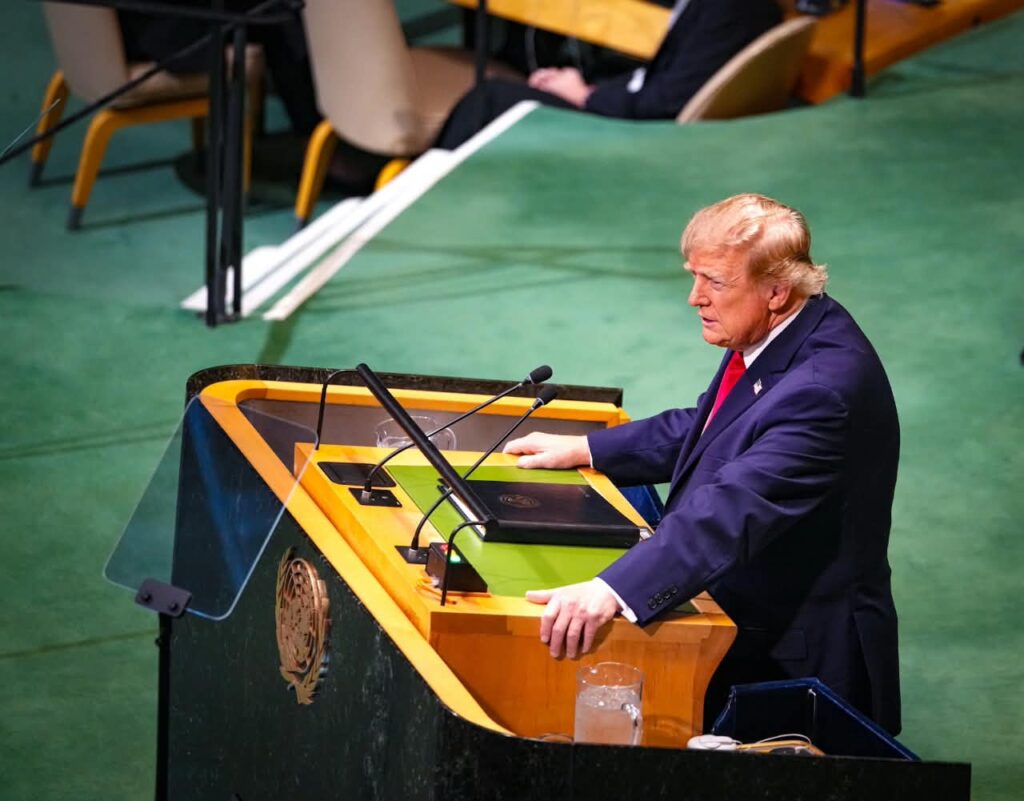
In an escalating war of words on the world’s grandest diplomatic stage, President Donald J. Trump delivered a stark, apocalyptic ultimatum to the Islamic Republic of Iran during his address to the United Nations General Assembly on Tuesday.
The speech prompted the majority of the Iranian delegation to stand up and walk out of the hall in direct protest.
Addressing world leaders at the 81st session of the General Assembly in New York, Mr. Trump directly confronted months of rising geopolitical tensions and military skirmishes between Washington and Tehran. Striking an unusually ominous tone, the president framed the future of U.S.-Iranian relations not as a ongoing negotiation, but as an existential fork in the road.
“I have a big decision to make: Will a deal be made with Iran that lets them rebuild and create a far greater country than it ever was before,” Mr. Trump declared, “or do I annihilate the Islamic Republic, and do it quickly, never giving them a chance to kill and destroy again?”
He continued to push the rhetoric further, asking the assembly: “Do I drive them into hell with no chance of survival and no hope of future greatness or generations?”
As Mr. Trump pivoted to the Iran section of his remarks, members of the Iranian delegation—who had been seated in the front rows of the green-marbled chamber—stood up and filed out. Iranian President Masoud Pezeshkian and Foreign Minister Abbas Araghchi, both in New York for the annual assembly, were not present in the chamber; lower-level representatives and diplomatic staff initiated the dramatic departure, leaving only a single junior diplomat behind to monitor the rest of the speech.
The dramatic walkout underscored the historic collapse in diplomatic protocol between Washington and Tehran, following months of expanding economic sanctions, regional maritime clashes near the Strait of Hormuz, and direct strikes on military infrastructure.
Despite his existential rhetoric, Mr. Trump asserted later in his address that he still anticipated a diplomatic resolution after the upcoming American midterm elections, claiming a deal remained achievable under the weight of U.S. pressure.
However, the theatrical exit of Iran’s representatives served as a visible reminder of how far apart the two adversaries remain.
The walkout was not the only diplomatic protest of the morning; the delegation from Cuba similarly exited the chamber later in the address after Mr. Trump characterized the island nation as an “absolutely failed state”.
The diplomatic collision at the United Nations comes after a tumultuous six-month period of escalating conflict between the United States and Iran. Following the collapse of multi-party nuclear negotiations, Washington reimposed maximum-pressure financial sanctions, while expanding naval patrols to secure international shipping lanes against Iranian interdiction in the Persian Gulf.
Tehran responded by accelerating uranium enrichment activities beyond levels seen previously, drawing warnings from international inspectors.
The confrontation occurs amid shifting political dynamics both domestically and internationally:
U.S. Political Reality: Domestic polling released by major networks indicates growing public skepticism regarding military engagements in the Middle East, with a substantial majority of voters expressing concern over the economic and foreign policy costs of protracted conflicts.
Visas & Regional Diplomacy: The Biden-Trump transition and subsequent administrative decisions resulted in targeted visa issuances for the U.N. summit. While Iranian officials were permitted entry to New York under headquarters agreements, tight geographical restrictions were placed on their movements within the city.
Simultaneously, administration officials have been conducting sideline meetings with Gulf Cooperation Council (GCC) partners to maintain regional alignment.
Walkouts at the U.N. General Assembly are a long-standing tool of diplomatic protest, particularly during speeches involving ideological adversaries. However, the explicit nature of Mr. Trump’s rhetoric—posing total destruction as a direct policy option before the assembly—marks one of the most severe public exchanges between the two nations since the 1979 Islamic Revolution.
REACTIONS TO TRUMP UN SPEECH
President Donald J. Trump’s apocalyptic ultimatum to Iran at the United Nations General Assembly—posing a stark choice between negotiating a deal or facing fast, complete annihilation—has drawn sharp, deeply polarized reactions across the U.S. political spectrum.
Democratic Party Reactions: Alarm and Constitutional Warnings
Democratic lawmakers and foreign policy strategists overwhelmingly condemned the speech as reckless brinkmanship that heightens the risk of an unintended, catastrophic military conflict.
Escalation Without Strategy: Senior congressional Democrats argued that threatening to “annihilate” a sovereign nation of over 85 million people undermines American moral authority and alienates key international partners required for effective regional diplomacy.
Constitutional Preemption: Key members of the House Foreign Affairs and Senate Foreign Relations Committees emphasized that the Executive Branch lacks congressional authorization for a preventive war against Iran. Several lawmakers reiterated that any preemptive strike or deliberate escalation toward regime destruction would require a formal declaration of war or specific Authorization for Use of Military Force (AUMF) from Congress.
Diplomatic Disruption: Analysts affiliated with left-leaning foreign policy institutions noted that dramatic rhetoric often backfires by strengthening hardliners inside Iran, undermining moderate factions, and shutting down remaining channels for back-channel communication.
Republican Party Reactions: Praise for Deterrence and Projecting Strength
Congressional Republicans and conservative foreign policy figures largely praised the address as a vital demonstration of American resolve and strategic clarity.
Restoring Maximum Deterrence: GOP leaders argued that explicit language is necessary to deter Iranian aggression, protect U.S. troops stationed in the Middle East, and secure critical international shipping lanes against regional threats.
Negotiating From Strength: Conservative allies framed the rhetoric as a classic application of “peace through strength,” asserting that Tehran only returns to serious negotiations when faced with a credible threat of devastating military consequences.
Highlighting Iran’s Isolation: Republican commentators highlighted the Iranian delegation’s dramatic walkout not as a failure of diplomacy, but as evidence of the regime’s inability to face accountability on the world stage.
The Non-Interventionist Conservative View: Caution on Commitment
Within the broader conservative ecosystem, non-interventionist factions expressed a more cautious interpretation.
While approving of the President’s “America First” stance and emphasis on domestic priorities, commentary from these groups cautioned against getting drawn into another costly, unpredictable foreign war.
They emphasized that the threat of “annihilation” must remain a deterrent rather than an opening move toward open-ended nation-building or protracted intervention.
Public and Media Perspective
Media coverage reflected the broader national debate:
Cable News Divisions: Mainstream networks debated whether the speech represented a calculated, high-stakes bluff designed to force quick concessions or a dangerous step toward armed conflict. Conservative outlets focused on the boldness of directly confronting hostile regimes, while progressive commentators warned of a breakdown in international diplomatic norms.
Voter Concerns: Polling indicates that while a majority of American voters favor curbing Iran’s regional influence and nuclear ambitions, there remains widespread public reluctance regarding new military engagements in the Middle East.