


By SCM Foreign Desk Published June 26, 2026
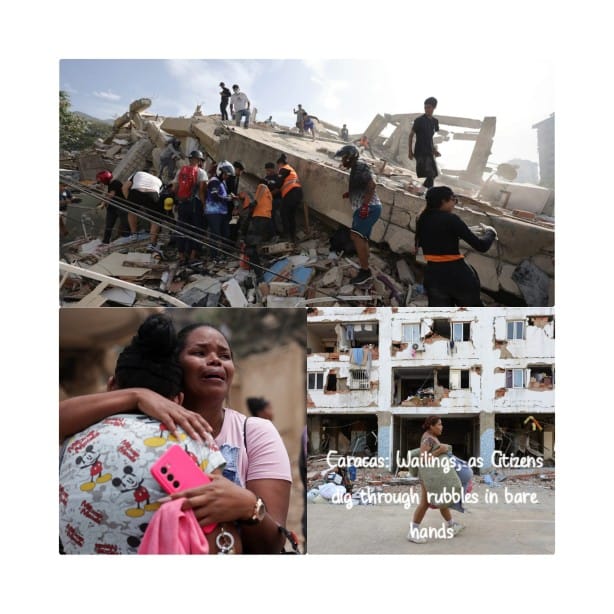
CARACAS, Venezuela — A pair of catastrophic, back-to-back earthquakes tore through north-central Venezuela, leveling high-rise buildings, shattering critical infrastructure, and reducing entire residential blocks to dust.
The dual tremors, which struck within 40 seconds of each other, have left at least 235 people dead and more than 4,300 injured, according to health officials. With over 40,000 citizens currently reported missing, authorities warn that the death toll is expected to rise exponentially as emergency crews claw through mounds of unstable concrete.
The national government has officially declared a state of emergency. Describing the event as a “true tragedy,” Acting President Delcy Rodríguez designated the capital district and neighboring coastal zones as disaster areas, unlocking emergency federal funding and mobilizing military personnel to handle what geophysicists call the most powerful seismic event to strike the nation in more than a century.
The disaster began during the late afternoon on Wednesday, June 24, a national holiday commemorating the Battle of Carabobo. Because of the holiday, thousands of residents were clustered in their homes rather than at work, a factor that officials fear may have drastically increased the casualty rate in densely populated residential towers.
According to data compiled by the United States Geological Survey (USGS), the first tremor — a magnitude 7.2 earthquake — struck at 6:04 p.m. local time, centered near San Felipe in Yaracuy State.
While residents were still rushing into the streets in panic, a massive magnitude 7.5 mainshock struck just 39 seconds later, localized near the Yumare-Morón area.
The USGS classified the rapid-fire event as a “seismic doublet” — two distinct major earthquakes occurring near the same time and geographic footprint. Because both tremors originated at a relatively shallow depth of roughly 10 kilometers (six miles) along the San Sebastián strike-slip fault system, the intense energy reached the surface with maximum, violent force.
The catastrophic shockwaves radiated outward across South America, prompting building evacuations as far away as Bogotá, Colombia, and the Amazonian city of Manaus, Brazil, more than 1,000 miles to the south.
In Caracas, a valley city ringed by mountains, the architectural damage is widespread. In the affluent eastern municipalities of Chacao and Altamira, multiple high-rise structures collapsed completely. Among them was a 22-story residential building that folded inward into a mountain of pancaked concrete slabs.
”The ground didn’t just shake; it felt as if it were being violently jerked back and forth,” said Alejandro Mendoza, 41, an engineer who escaped his crumbling apartment building in the Los Palos Grandes neighborhood.
“By the time the second shock hit, the dust was so thick you couldn’t breathe. When it stopped, the building across the street was simply gone.”
To prevent catastrophic urban infernos, the government immediately ordered the municipal gas supply turned off across Caracas.
Public transit, including the sprawling Caracas Metro system, has been entirely suspended. Hospitals, already strained by years of economic precarity, have been utterly overwhelmed, with triage centers erected in parking lots and public plazas to treat thousands of patients suffering from crush injuries, fractures, and severe lacerations.
Beyond the capital, the coastal state of La Guaira sustained near-total devastation. Over 100 buildings collapsed along the coastline, and Simón Bolívar International Airport, the primary aviation gateway to the country, suffered massive structural failure.
Runways were torn apart and control towers cracked, forcing the immediate cancellation of all commercial flights and isolating the nation from standard aerial supply lines.
As more than 30 significant aftershocks continue to rattle the region, local civil protection teams, Red Cross volunteers, and municipal police are racing against the clock.
Heavy machinery is scarce, leaving first responders and desperate citizens to dig through the debris using sledgehammers, shovels, and their bare hands.
The predictive Pager modeling issued by the USGS notes a high statistical probability that the true human cost could reach between 10,000 and 100,000 fatalities, given the structural vulnerability of many older structures and informal hillside settlements (barrios) that ring Caracas.
These informal neighborhoods, composed of stacked brick dwellings built on steep inclines, are highly susceptible to secondary landslides triggered by seismic shaking.
International aid has begun to mobilize despite complex diplomatic hurdles. United States Secretary of State Marco Rubio announced that the U.S. is prepared to deploy specialized search-and-rescue teams, canine units, and emergency medical supplies to the region. Meanwhile, neighboring Colombia has mobilized its own disaster response frameworks along the western border, waiting for formal clearance to assist.
With power grids shattered and telecommunications networks offline across major swathes of north-central Venezuela, families wait in the dark, listening for the sounds of survivors trapped beneath the ruins of their capital.
For a closer look at the immediate aftermath, structural damage, and ongoing rescue efforts on the ground, you can watch this report on the Devastating Back-to-Back Earthquakes in Venezuela, which features expert geological analysis alongside direct eyewitness testimony from Caracas.