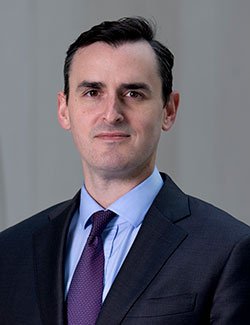

By Emmanuel Ukudolo I Friday, Nov.07,2025
WASHINGTON – Dan Katz, the International Monetary Fund, IMF First Deputy Managing Director, has warned that the global economy is being fundamentally “redesigned,” driven not just by efficiency but by a new focus on long-term resilience amid rising geopolitical tensions and evolving financial risks.
In his opening remarks at the 26th Jacques Polak Annual Research Conference in Washington, Mr. Katz challenged policymakers and researchers to rethink long-held assumptions about international economic integration, particularly concerning trade and global imbalances.
Mr. Katz zeroed in on the impact of state intervention on the traditional gains from trade. He noted that while the classic Ricardian model suggests universal benefits from specialization, this relies on economies exhibiting flexibility and lacking distortions.
”When state interventions inhibit economic flexibility and persistently distort the pattern of comparative advantages, do the gains from trade still hold?” he asked. “Can we still rely on trade to be a driver of not only short-term efficiency, but also sustainable and balanced growth amongst countries with fundamentally different models for state influence on the economy?”
The speech highlighted the increasing use of non-tariff barriers, specifically export controls, as a potentially more disruptive force than tariffs. Mr. Katz cautioned that while export controls have historically covered dual-use and frontier technologies like advanced semiconductors, their increasing application to legacy components, such as rare earth magnets, poses a systemic risk. A sudden cutoff of these critical inputs could trigger “production shutdowns that could cascade across supply chains and would ripple through the economy and the financial system.”
The IMF official also expressed deep concern over the widening of global imbalances—excess current account surpluses and deficits—which reached the largest increase in a decade in 2024. He stressed that while domestic action, like investment expansion in Germany or fiscal consolidation in the UK and US, is necessary, the causation may run both ways, with one country’s imbalances influenced by those of others.
Mr. Katz questioned the efficacy of relying purely on domestic measures and asked what countries should do if their efforts are “insufficient to rebalance, and if other countries are unwilling to address the domestic imbalances that cause the spillovers.”
Furthermore, he raised the potential for systemic risks emanating from stock imbalances, where countries’ net foreign asset positions deviate significantly from sustainable levels, even if flow imbalances are being addressed.
In financial markets, Mr. Katz noted the growing dominance of non-bank financial intermediation in core funding markets, warning that this shift “may increase the potential for rapid transmission of shocks,” potentially resulting in “painful domestic adjustments” from rapid repricings rather than deliberate policy planning.
Geopolitical Fragmentation and Specialization
The final theme focused on the interplay between geopolitical fragmentation and economic integration. While regionalization spurred by closer ties is welcome, Mr. Katz warned that deeper integration among neighbors with varying degrees of state involvement “could paradoxically create distortions, disruptions and vulnerabilities that negatively impact geopolitical stability.”
He challenged the long-standing view of specialization, asking if a successful modern economy can outsource all types of economic activity. The IMF official suggested that policymakers should differentiate between types of specialization, contemplating whether sectoral imbalances—even without excessive aggregate imbalances—could be problematic, potentially leading to resource misallocation and exacerbated security concerns.
The conference is set to explore these issues further, with sessions featuring research on trade dynamics, global value chains, capital flows, and policy tradeoffs.