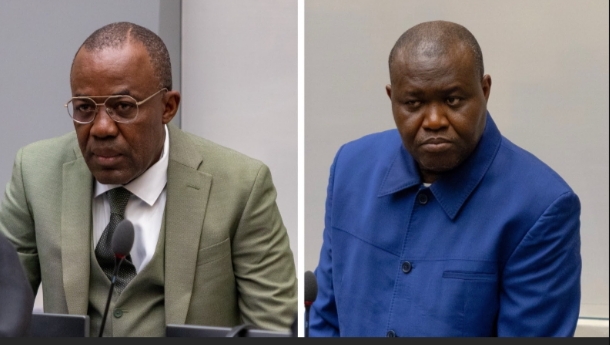
Admin I Thursday, July 24, 2025
THE HAGUE – The International Criminal Court, ICC has found Alfred Yekatom and Patrice-Edouard Ngaïssona guilty of war crimes and crimes against humanity and sentenced them to 15 and 12 years of imprisonment.
The Chamber found Mr Ngaïssona and Mr Yekatom guilty beyond any reasonable doubt of a number of war crimes and crimes against humanity which took place in Bangui and the west of the Central African Republic (“CAR”) between September 2013 and at least February 2014.
The Chamber, composed of Judges Bertram Schmitt, Presiding, Judge Péter Kovács, Judge Chang-ho Chung, Judge Beti Hohler, Alternate Judge, sentenced Alfred Yekatom to a total of 15 years of imprisonment and Patrice-Edouard Ngaïssona to a total of 12 years of imprisonment.
The duration they have spent in detention will be deducted from their sentences, the judges said.
The Chamber noted the context in which the crimes were committed during the conflict in CAR between the Seleka and the Anti-Balaka.
The Seleka, opposing then-president François Bozizé, emerged around August 2012, led by CAR citizens, and was composed mainly, but not exclusively, of Muslims. It also included elements from Chad and Sudan.
On 24 March 2013, the Seleka took control of Bangui and of power in the CAR. Michel Djotodia, the Seleka leader proclaimed himself president. The Seleka committed violence and abuses across the CAR, in particular against individuals considered to be associated with François Bozizé and against non-Muslims, mostly Christians but also animists or others.
Mr Ngaïssona, according to the ICC was actively involved in planning steps to respond to the Seleka violence in the CAR and to ensure François Bozizé’s return to power.
At the same time, Mr Yekatom started forming a group with Freddy Ouandjio, also known as ‘Coeur de Lion’, and Habib Beina. With other groups that initially were formed separately, they formed one movement, and started coordinating their activities against a common enemy, the Seleka. This movement came to be known as ‘Anti-Balaka’.

The Chamber found that Mr Ngaïssona was actively engaged in formalising the structure of the Anti-Balaka. He also continued providing financial assistance. It also found that, throughout the relevant period, Mr Yekatom retained and exercised full and unrestricted control over his group.
This group was seen as and understood to be part of the Anti-Balaka. Mr Yekatom and Mr Ngaïssona knew that the Anti-Balaka perceived, and themselves perceived, the Muslims in the CAR as collectively responsible for, complicit in, or supportive of the violence and abuses committed by the Seleka and that the Anti-Balaka targeted the Muslim civilian population, specifically in the west of the CAR, on this basis, namely during the widespread attack that ultimately took place from September 2013 through February 2014, including the seminal coordinated Anti-Balaka attacks of Bangui and Bossangoa on 5 December 2013.
Although this case concerned crimes specifically against Muslim civilians or individuals considered as such, the Chamber emphasised that it has not found the relevant conflict in the CAR to be of a religious nature at the outset. Many witnesses, non-Muslims and Muslims alike, have stated before the Court that before the conflict, they lived together peacefully. However, the different groups and their leaders instrumentalised religion to gain political and economic power.
Alfred Yekatom has been found guilty of a number of crimes he committed in the context of the attack on Bangui, the events at Yamwara, and during the advance of his group on the PK9-Mbaïki axis, namely attacks against the civilian population as such, murder, forcible transfer/displacement and deportation, directing an attack against a building dedicated to religion, torture, cruel treatment, other inhumane acts, imprisonment and other severe deprivation of physical liberty, and persecution.
Further, Patrice-Edouard Ngaïssona has been found guilty of a number of crimes he aided, abetted or otherwise assisted to in the context of the attacks on Bangui and Bossangoa, the events at Yamwara, and during the advance of the Anti-Balaka on the PK9-Mbaïki axis, namely attacks against the civilian population as such, murder, forcible transfer/displacement and deportation, directing an attack against a building dedicated to religion, torture, cruel treatment, other inhumane acts, imprisonment and other severe deprivation of physical liberty, destruction of property and persecution.
This is by majority in relation to the war crime of torture and the war crime and crime against humanity of murder concerning Saint Cyr. Judge Kovács dissented in this regard.
The Chamber has not upheld the charges against Mr Ngaïssona of the war crimes of pillaging and directing an attack against a building dedicated to religion in connection with the attack on Bossangoa. The Chamber has also not found Mr Ngaïssona responsible for the rape that took place in Bossangoa.
The Chamber by majority, Judge Chung dissenting, has not upheld the charge against Mr Yekatom of the war crime of conscription, enlistment and use of children under the age of 15 years to participate actively in hostilities.