


- IISuicide is the other option for me
By Emmanuel Ukudolo I Tuesday, October 13, 2026
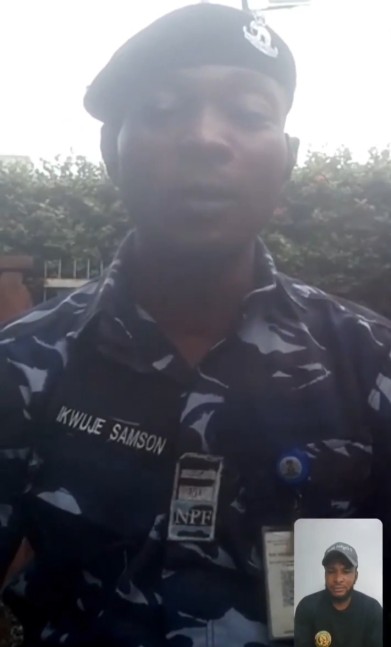
ENUGU, Nigeria – A SERVING police officer has issued a heartbreaking cry for help, confessing he contemplated suicide as he struggles to feed his family on meager wages and buy his own uniform.
Inspector Kwuje Samson, currently serving in Enugu State, Nigeria, has bravely broken rank to expose the severe hardships, institutional neglect, and systemic corruption grinding down over 200,000 rank-and-file officers.
In an astonishing and rare public outburst, Inspector Samson revealed that despite dedicating nearly a quarter of a century to public service, his monthly earnings leave him unable to afford basic human necessities, including his children’s school fees.
“The suffering police officers are going through is too much,” Inspector Samson disclosed in a candid statement. “In a few months, I will be 24 years in service. My salary cannot take care of me. I can’t pay for my children’s school fees. I have to call my brother to help me each time.”
The veteran officer painted a stark picture of daily hardship, detailing how financial exhaustion forces him to trek miles every day just to ensure his children receive an education.
“Every day, I have to trek for about one kilometer to take my children to school, and the same distance to bring them back,” he added.
Among the most damning allegations raised by the inspector is the total failure of the authorities to provide standard-issue gear—a neglect that forces officers to pay out-of-pocket for uniforms they are legally required to wear.
“Since I joined the force 24 years ago, uniform has been provided for me only once,” Inspector Samson revealed. “It’s from my salary that I buy my uniform, whereas it is supposed to be provided quarterly.”
The crisis has driven many officers to the absolute brink. Inspector Samson admitted that the relentless mental and financial strain nearly pushed him to end his life, before he chose instead to blow the whistle on behalf of his colleagues.
“I contemplated suicide to end it all, but I decided to take the option of speaking up,” he said. “I speak for over 200,000 policemen. We are suffering, but we cannot keep quiet anymore. I know the consequences of speaking up, but the consequence is not worth the suffering.”
He called for an immediate investigation into the management of police funding, demanding accountability from the highest levels of government. “We want to know if it’s the President who has not been releasing the money, or if it is the system,” he demanded.
Inspector Samson also shed light on the systemic rot that fuels widespread police extortion, explaining that dire poverty drives many officers to solicit bribes from motorists simply to avoid starvation.
“I am not corrupt and I don’t collect money from anyone. But it is because of the suffering that most policemen collect money from motorists,” he explained. “If not for the motorists, most policemen would not be able to survive.”
The West African nation’s law enforcement apparatus has long faced intense public scrutiny over widespread allegations of extortion, brutality, and corruption. However, Inspector Samson’s raw testimony highlights the systemic labor violations and welfare neglect experienced by low-ranking personnel behind the scenes.
In recent years, rank-and-file Nigerian Police Force (NPF) officers have complained of delayed salary payments, inadequate housing allowances, dangerous working conditions, and an absence of basic operational equipment.
While government budgets allocate funding for police welfare and quarterly uniform distribution, low-level personnel routinely claim these funds are siphoned off by administrative bottlenecks or top-level corruption.
Under police regulations, serving officers are strictly barred from publicly criticizing the force or speaking to the media without official clearance. Whistleblowers frequently face severe disciplinary measures, including summary dismissal, loss of pension rights, or arrest.
By coming forward publicly, Inspector Samson risks his 24-year career to shine a spotlight on a humanitarian crisis brewing within the ranks of national security forces.