


By SCM Staff Writer
PORT HARCOURT — A former Minister of Petroleum Resources and Foreign Affairs, Mr. Henry Odein Ajumogobia, SAN, has strongly advocated for the strengthening of the Niger Delta Development Commission (NDDC) to position it as the definitive arrowhead of all development agencies operating within the oil-rich region.
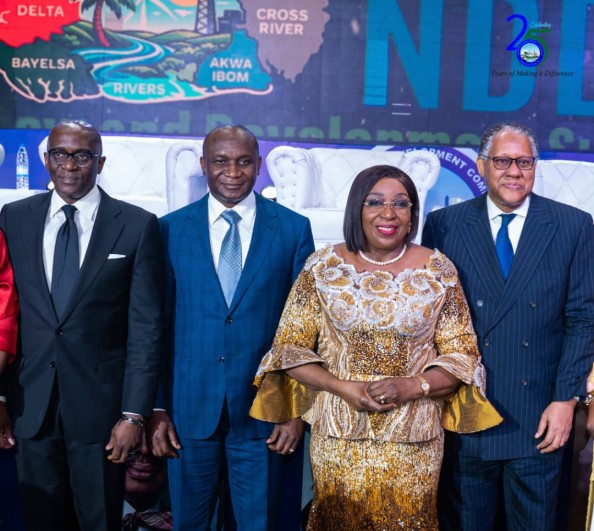
Ajumogobia made this passionate call while delivering the keynote address at the high-level NDDC Law and Development Summit held in Port Harcourt, the Rivers State capital.
He stressed that it has become imperative for the Federal Government and international partners to support the commission in its statutory role as the central coordinating body to halt the underdevelopment of the region.
Lamenting the current state of affairs, the former minister observed that structural defects have hindered the commission from achieving its full potential.
According to him, rather than driving the development agenda, the commission has been forced to navigate a cluttered operational space.
“Rather than functioning as the central coordinating body, the NDDC has become one layer in a crowded ecosystem where responsibilities are diffuse and unclear.
This has produced patterns of duplication in which multiple actors work at cross-purposes while oil-producing communities remain underdeveloped,” Ajumogobia lamented.
He further acknowledged the severe constraints faced by the commission, noting that its limitations are deeply structural rather than merely administrative.
He described the region’s current governance architecture as fragmented, characterised by overlapping mandates among federal institutions, state governments, private sector actors, corporate social responsibility (CSR) initiatives, and various development programmes.
Echoing the keynote speaker’s sentiments, the Chairman of the NDDC Governing Board, Mr. Chiedu Ebie, underlined the inseparable bond between law and regional development, describing it as foundational.
Ebie argued that law must not be viewed merely as a set of restrictive rules, but rather as a living instrument for social engineering, economic transformation, institutional strengthening, and environmental sustainability.
Speaking on the theme of the summit, “The Role of Law in Driving Sustainable Development in the Niger Delta,” Ebie described the discourse as both timely and transformative for a region that has suffered long-standing paradoxes.
“For the people of the Niger Delta, a region whose vast natural wealth has for too long stood in painful contrast to the poverty and neglect of its communities, these are not abstract ideals.
They are urgent, lived realities. The aspirations of our people demand nothing less than a legal architecture that is bold, responsive, and fit for purpose,” Ebie stated.
The Board Chairman revealed that the current leadership has adopted creative and innovative strategies to navigate the complex socio-economic terrain of the region.
He maintained that while the commission operates strictly within the ambit of the law, it refuses to be constrained by a narrow or uninspired reading of its mandate, leading to a total repositioning of its internal governance.
Moving from Transactions to Transformation
In his opening remarks, the Managing Director and Chief Executive Officer of the NDDC, Dr. Samuel Ogbuku, reiterated that sustainable development goes beyond infrastructural projects.
He maintained that long-term well-being requires a balanced integration of economic growth, social inclusion, and robust environmental protection.
Dr. Ogbuku asserted that since the current Board and Management assumed duty, deliberate and intentional efforts have been made to transition the NDDC from a “transaction-oriented” agency to a “transformation-driven” institution.
Highlighting some of the landmark administrative reforms under his watch, Ogbuku revealed a strategic partnership with world-renowned consulting firm, KPMG Advisory.
“When we came on board, we discovered that the Commission’s internal processes required administrative recalibration to carry out the ambitious reforms we needed. We engaged world-renowned KPMG Advisory, who reviewed our processes and developed new Corporate Governance policies that now form the bedrock of our internal governance,” the MD stated.
In a major stride toward transparency, the Managing Director announced that the commission has successfully reformed its procurement systems to eliminate opaqueness.
“As of today, the NDDC has almost 90 per cent of its processes digitalised. We have implemented mechanisms for contractors and stakeholders to sign and execute their contracts electronically from the comfort of their homes and offices, with minimal physical contact,” Ogbuku revealed.
He added that the Law and Development Summit was birthed out of the need to consolidate these gains by strengthening the legal frameworks guiding the commission’s operations through collaboration with legal experts, development partners, and sustainability professionals.
Earlier in his remarks, the NDDC Director of Legal Services, Sir Victor Arenyeka, reminded participants that the NDDC is a creation of law, regulated by its Establishment Act and other complementary statutes.
Arenyeka explained that the summit was specifically designed as a strategic platform for policymakers, legal practitioners, traditional institutions, environmental advocates, and civil society organisations to critically brainstorm on how law, governance, and institutional accountability can be deployed as effective tools for the total transformation of the Niger Delta.