


Admin I Thursday, July 16, 2026
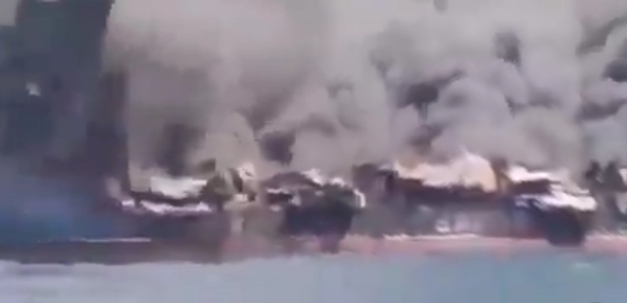
THE world was pushed to the absolute brink of World War Three today after Iranian forces blasted a US ship out of the water in the highly contested Strait of Hormuz.
A barrage of anti-ship missiles and explosive suicide drones struck the American vessel as it attempted to transit the narrow chokepoint, sending shockwaves through global capitals and causing oil prices to instantly skyrocket.
The shocking attack marks the most dangerous escalation yet in the ongoing US-Iran conflict, shredding any hope of salvaging the fragile 60-day ceasefire agreed last month.
US Central Command (CENTCOM) confirmed the devastating strike, while military sources in Washington whispered that President Donald Trump has already convened an emergency National Security Council meeting, warning Tehran there will be “hell to pay.”
What Happened in the Strait of Hormuz?
The drama unfolded in the early hours of Thursday morning when the US vessel was navigating the perilous shipping lane. Under a strategic US military protocol, ships have been using a southern transit route hugging the coastline of Oman to bypass Iranian territorial waters.
But the Islamic Revolutionary Guard Corps (IRGC) has repeatedly declared the route “unauthorized,” claiming complete control over who gets to pass.
According to reports from the region:
The Interception: IRGC fast-attack boats swarmed the US vessel, issuing chaotic radio warnings to “change course or be targeted”.
The Strike: When the ship maintained its international transit path, Iran launched a devastating, coordinated barrage of land-based anti-ship cruise missiles alongside swarms of loitering munitions.
The Sinking: Despite the vessel’s onboard air defense systems engaging the incoming threats, multiple direct hits tore through the hull, sparking a catastrophic engine room fire and forcing the crew to abandon ship before it went under.
”The era of US bullying is over,” crowed an IRGC military spokesperson in Tehran shortly after the attack. “Any foreign military force attempting to violate our sovereign sea protocols will be met with immediate destruction.”
The Strait of Hormuz is a tiny, hook-shaped waterway separating Iran and Oman. At its narrowest point, the shipping lanes are only two miles wide. Yet, it is the absolute jugular vein of the global economy:
Energy Lifeline: Roughly 20% (one-fifth) of the world’s total petroleum and natural gas flows directly through this narrow strait.
No Alternative: There are very few bypass pipelines available; if the Strait is successfully blocked or deemed a warzone, global energy markets face immediate paralysis.
Sovereignty Dispute: While international law designates the strait as an international waterway, Iran insists it has the sole right to police, block, or even charge transit fees to passing vessels.
Decades of Tension Boil Over
This devastating sinking did not happen in a vacuum. It is the culmination of a brutal, month-long cycle of violence:
Only days ago, the US military launched a massive wave of strikes hitting more than 140 Iranian military targets—including drone launch sites and coastal radar systems—after Iran disabled a civilian container ship. Iran retaliated by launching strikes against US bases and allies in Bahrain, Kuwait, Qatar, and Oman.
The sinking of an actual American vessel, however, crosses a definitive red line that makes a full-scale US ground and air war against Iran highly likely
Global stock markets have already plunged into freefall, with Brent crude oil prices spiking by over 15% within minutes of the news breaking.
Military analysts warn that a massive,
overwhelming US retaliatory strike on Iran’s mainland assets is now inevitable. “This is no longer a localized skirmish,” warned one defense expert. “We are looking at the very real possibility of a wider regional war that could draw in global superpowers.”
As the smoke clears over the Gulf, the world holds its breath to see how Washington responds to the ultimate provocation.