


By SCM Global Energy Desk
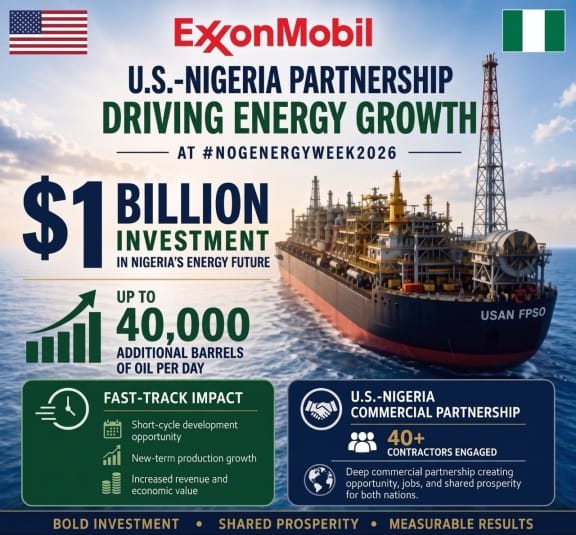
ABUJA, Nigeria — In a major commitment to Africa’s largest petroleum market, ExxonMobil and its international joint-venture partners have unveiled a $1 billion deepwater investment plan aimed at injecting up to 40,000 barrels of crude oil per day into Nigeria’s daily output.
The announcement, made during the 25th NOG Energy Week conference in Abuja, marks ExxonMobil’s first substantial drilling campaign in Nigeria’s offshore sector since 2016, signaling a turn for an energy industry that has grappled with years of operational headwinds, pipeline sabotage, and underinvestment.
The campaign, known as the Usan Infill Project, targets the offshore Usan field located in Oil Mining Lease (OML) 138, roughly 60 miles off the coast of the Niger Delta. Executed through ExxonMobil affiliate Esso Exploration and Production Nigeria Offshore East Limited under a Production Sharing Contract (PSC) with state-owned NNPC Limited, the venture includes international partners Chevron, TotalEnergies, and CNOOC subsidiary Nexen.
“This is what U.S.-Nigeria partnership delivers: bold investment, shared prosperity, and measurable results that strengthen our nations’ economic ties for years to come,” said Jagir Baxi, Chairman, Managing Director, and Lead Country Manager for ExxonMobil affiliates in Nigeria.
Unlike complex, multi-year greenfield megaprojects that often take up to a decade to deliver initial volumes, the Usan Infill Project has been structured as a fast-track, short-cycle development. Relying on advanced 3D seismic acquisition and subsea processing technology completed in 2024, project engineers plan to tie new infill wells directly into existing floating production, storage, and offloading (FPSO) infrastructure already deployed in OML 138.
Initial production is projected to commence within six months of execution, reaching peak capacity of 40,000 barrels per day within 18 months.
The supply chain driving the project relies heavily on cross-border commercial ties. More than 40 primary contractors are involved in subsea equipment deployment and engineering services. Among them are six major U.S.-based oilfield service companies with deep roots in Nigeria, reflecting the expanding role of American technical expertise in modernizing West Africa’s deepwater assets.
Background: Rebuilding Confidence in Nigeria’s Energy Sector
The $1 billion commitment comes at a crucial juncture for Nigeria, an Organization of the Petroleum Exporting Countries (OPEC) member that has struggled to consistently hit its production quotas over the past five years.
Historically reliant on onshore and shallow-water fields in the Niger Delta, Nigeria saw its oil output fall from historical peaks near 2.2 million barrels per day down to periods under 1.2 million barrels per day in recent years. Widespread oil theft, pipeline vandalism, and community friction in onshore regions drove major Western oil firms—including Shell, TotalEnergies, and ExxonMobil—to re-evaluate their portfolios, often selling onshore leases to domestic firms while reallocating capital to deepwater projects miles offshore where production is less vulnerable to physical disruption.
To arrest the decline and attract fresh foreign direct investment, the Nigerian government enacted the landmark Petroleum Industry Act (PIA) and subsequently issued executive orders aimed at streamlining project approvals, reforming tax structures, and offering fiscal incentives for deepwater operators.
The Nigerian Upstream Petroleum Regulatory Commission (NUPRC) framed the Usan announcement as a direct validation of those regulatory overhauls. Commission Chief Executive Oritsemyiwa Eyesan noted that the 2022 renewal of OML 138’s lease for an additional 20 years laid the groundwork for this return to active drilling.
“The investment is particularly noteworthy because it marks ExxonMobil’s return to active drilling operations in Nigeria after nearly a decade,” Eyesan said, adding that the regulatory body projects the infill initiative to generate an estimated $1.2 billion in additional revenue for the federal government over the next four years.
Since production first began in the Usan field 14 years ago, ExxonMobil and its joint-venture partners have invested over $16 billion in the block, yielding more than 350 million barrels of crude oil and contributing roughly $4.6 billion in direct fiscal value to Nigeria.
For global energy markets, the project demonstrates how short-cycle infill drilling can generate rapid supply additions without the capital intensity of new greenfield builds.
For Nigeria, it represents a crucial step toward stabilizing state revenues and restoring its position as West Africa’s leading energy exporter.