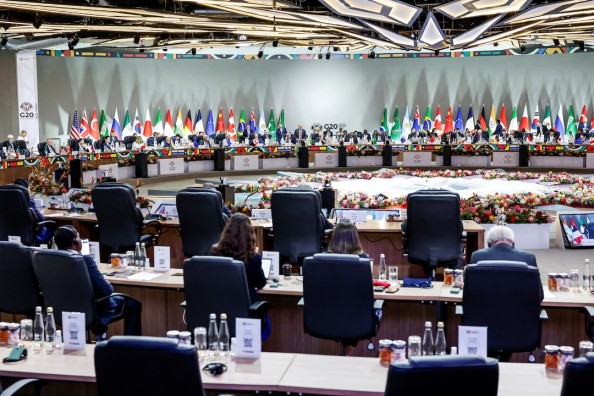

- Leaders at the G20 Summit in South Africa
By SCM Correspondent in SA I Monday, Nov.24.25
JOHANNESBURG – The African Energy Chamber (AEC) has issued a strident call to the G20, meeting in Johannesburg, for a “fundamental reorientation of global energy policy,” demanding that African fossil fuels be placed at the core of international efforts to achieve energy security, industrial growth, and poverty alleviation.
In a statement released on Monday, the AEC rejected global transition rhetoric that seeks to phase out fossil fuels, arguing that policies “rooted in ideology” have long sidelined Africa’s vast potential.
The Chamber explicitly endorsed the mantra to “drill, baby, drill”—responsibly and strategically—to meet the needs of the hundreds of millions of Africans who currently live without access to reliable energy.
The demand comes as key African economies move aggressively to unlock hydrocarbon wealth. South Africa’s Minister of Mineral and Petroleum Resources, Gwede Mantashe, underscored this domestic focus at the G20 Africa Energy Investment Forum, stating: “We have no legal restriction on oil and gas exploration and exploitation in South Africa. If we make a breakthrough on oil and gas, our GDP will grow exponentially.”
The central grievance of the AEC is the growing constraint on capital flows. The Chamber warned that restrictive frameworks, including the World Bank’s fossil-fuel lending ban and risk-averse policies by Western banks, threaten to “choke off investment where it is needed most.”
The blockage of capital is occurring despite robust projected growth and significant upstream ambition.
The AEC’s 2026 Outlook forecasts oil and gas production to reach 11.4 million barrels per day (bpd) by 2026, climbing towards 13.6 million bpd by 2030. The continent is expected to account for roughly $41 billion in global upstream capital expenditure by 2026, driven by major projects in Mozambique, Angola, and Nigeria. Exploration activity is gaining momentum in frontier basins, including Namibia, Sierra Leone, and Tanzania.
Gas: A Lifeline, Not Just a Transition
The AEC stressed that natural gas, with proven reserves exceeding 620 trillion cubic feet, is not merely a transitional fuel but a “lifeline” for industrialisation and development. Approximately 600 million Africans lack electricity, and 900 million have no access to clean cooking solutions.
Strategic investment in gas-to-power infrastructure, modular GTL, and LNG is essential to bridge this energy poverty gap, the Chamber argued.
While commending the United States’ landmark $4.5 billion financing commitment to Mozambique’s LNG project as a model, the AEC urged the G20 to champion financing for exploration rather than penalise it.
The statement concluded with a direct challenge to the global energy community, calling on the International Energy Agency (IEA) to “reset its projections,” which the AEC claims undervalue the continent’s hydrocarbon resources.
The Chamber called on the G20 to dismantle ideological barriers and make fossil-fuel development a central pillar of its Africa policy, enabling African governments, from Angola to Egypt, to deliver the necessary capital, technology, and partnerships.