


Admin I Monday, March 30.26
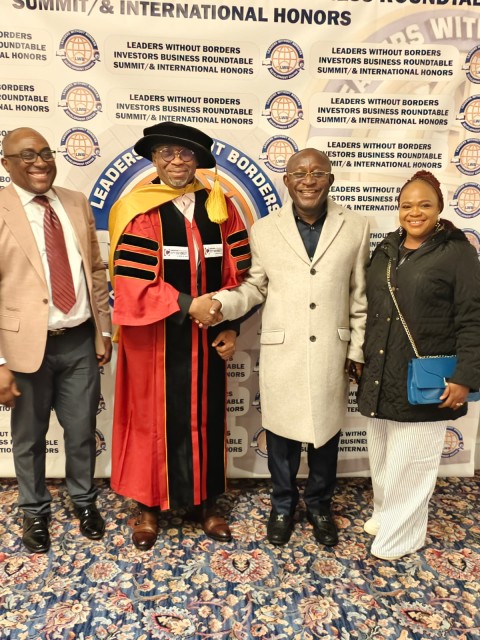
LONDON – Africa must move beyond viewing digital broadcasting as merely a regulatory compliance requirement and instead recognise it as vital strategic economic infrastructure capable of fostering inclusive trade and attracting cross-border investment, the Director General of Nigeria’s National Broadcasting Commission (NBC), Dr. Charles Ebuebu, has declared.
Delivering the keynote speech at the Leaders Without Borders Development Centre Investors Business Roundtable Summit in the United Kingdom, Dr Ebuebu stressed that connectivity alone is not enough for sustainable economic growth.
Referencing International Telecommunication Union (ITU) data showing that only 38% of Africa’s population used the internet in 2024 — compared to a global average of 68% — he highlighted broadcasting as being at the crucial intersection of media, telecommunications, advertising, data, and platform economies.
“Digital broadcasting is no longer just about transmission towers, signal carriage, or the migration from analogue to digital platforms,” Ebuebu stated. “It influences what businesses can sell, who can see their products, how quickly information travels, how market confidence is built, and how cross-border investment is attracted. It is a powerful engine for market discovery and economic development.”
The NBC Director General, a fellow of the International Alliance of Business Professionals, cited World Bank research indicating that intensive deployment of digital technologies can significantly boost productivity and exports.
He warned, however, that fragmented national policies across the continent are undermining Africa’s full potential.
Using Nigeria as a key example, Mr Ebuebu highlighted that the telecommunications sector contributed 14.40% to the country’s GDP in Q4 2024, while the creative industry — particularly film and entertainment — continues to serve as a major driver of employment and economic activity.
To fully unlock the economic value of digital broadcasting, Mr. Ebuebu called for five urgent policy actions:
1. Expand digital infrastructure across the continent to close connectivity gaps.
2. Develop adaptive regulation suited to a converged broadband-broadcasting environment.
3. Establish credible and transparent investment rules to attract long-term capital.
4. Treat skills development as critical infrastructure, building the human capacity needed for the digital economy.
5. Fully operationalise the African Continental Free Trade Area (AfCFTA) for media and creative products to foster intra-African trade.
In a statement issued by Clementine Usman-Wamba, Head of the Digital Switchover (DSO) Office and Deputy Director of Public Affairs, Mr Ebuebu was quoted as saying: “If governments and regulators continue to see broadcasting as a static compliance sector, they will miss its broader economic role. But if they regard it as a platform for innovation and convergence, then broadcasting becomes an integral part of the productive framework of the economy.”
Dr Ebuebu’s visit to the UK coincides with Nigeria’s significant milestone: the National Broadcasting Commission’s leapfrogging of the transition from analogue to digital broadcasting, in line with the International Telecommunication Union (ITU) treaty. A formal national launch of the DSO Digital-to-Home (DTH) and the freeTV Mobile App Platform is scheduled for May 2026.