


By Our Gaza Correspondent
KHAN YOUNIS, Gaza Strip — She had lived for only twelve months—long enough to learn the rustle of a plastic tarp against the desert wind, but not long enough to know a home made of concrete.
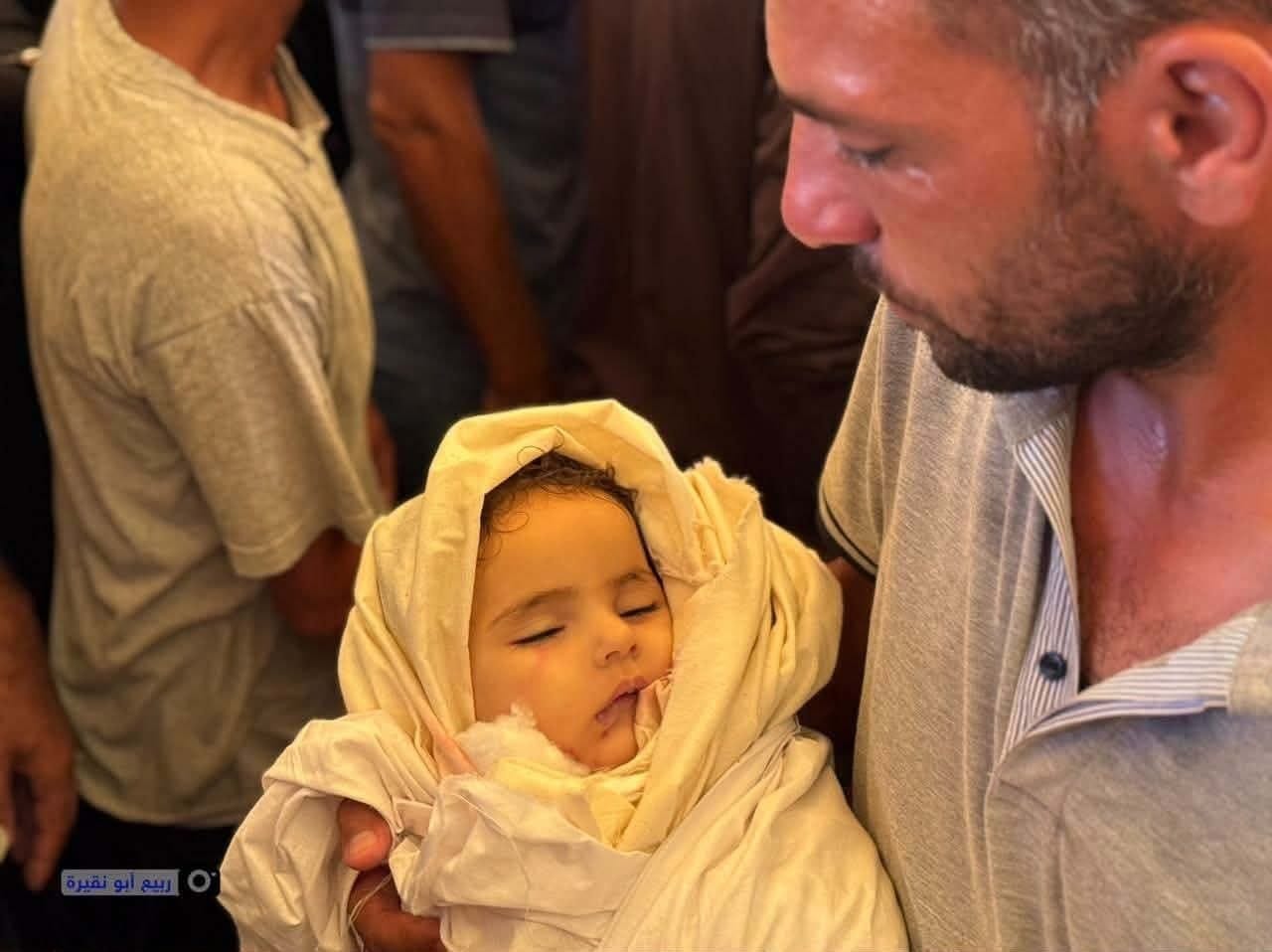
On Monday, Sewar Abu Deraz, a one-year-old Palestinian girl, was killed alongside her 23-year-old mother, Diana Abu Deraz, when an Israeli airstrike hit the makeshift tent camp where they were sheltering in the Al-Mawasi district of Khan Younis, in the southern Gaza Strip.
According to medical officials at the nearby Nasser Hospital, where the bodies were taken, the mother and daughter were killed instantly when the strike tore through the fabric and wood of the displaced persons’ camp.
The area, a narrow strip of coastal dunes, has become a teeming expanse of nylon and canvas shelters housing hundreds of thousands of Palestinians who have fled successive military offensives.
The deaths of Diana and her infant daughter underscore the harrowing, ongoing cost borne by civilians in Gaza, where even areas explicitly designated as humanitarian “safe zones” by the Israeli military have frequently come under bombardment.
Background: The Reality of Al-Mawasi
The strike on Monday occurred in Al-Mawasi, a rural, coastal region west of Khan Younis that lacked electricity, running water, or sewage infrastructure before the war. Early in the conflict, the Israel Defense Forces (IDF) directed hundreds of thousands of evacuees to flee to this specific zone, framing it as a sanctuary from active combat operations.
However, the reality on the ground has been far from safe. Over the course of the long conflict, Al-Mawasi has seen several high-casualty airstrikes.
The Israeli military has frequently stated that its strikes are precise operations based on intelligence targeting Hamas operatives who use civilian infrastructure and displaced camps as cover.
In Monday’s wave of strikes across southern and central Gaza—which killed at least eight people, including two children—the military maintained it was targeting active militants, though it did not immediately release specific details regarding the target in the Al-Mawasi camp.
For the families living in the camps, the distinction matters little. The strike left behind charred ruins of family belongings, mangled metal frames, and a community plunged into mourning. Relatives at Nasser Hospital wept over the small, shrouded body of Sewar, wrapped tightly alongside her young mother.
The killings come during a deeply precarious period for the enclave. While a formal ceasefire agreement took effect in October, halting the heaviest months of all-out warfare, a true peace has remained elusive.
The ceasefire successfully reduced the intensity of the conflict and saw partial troop pullbacks, yet near-daily drone strikes, artillery shelling, and targeted aerial bombardments have persisted.
Data from local health officials indicates that since the October ceasefire agreement was enacted, more than 1,000 Palestinians have been killed in scattered violence and localized strikes, including hundreds of women and children.
The Israeli military has defended these actions as necessary defensive responses to ceasefire violations, claiming that militants continue to plot attacks against the remaining Israeli troops who still control more than 60 percent of the Gaza Strip.
The continuous attrition keeps the displaced population in a state of permanent terror. With more than 73,000 Palestinians killed since the initial outbreak of the war following the Hamas-led October 7 attacks—which claimed 1,200 Israeli lives and saw 251 taken hostage—the psychological toll on survivors is immense.
International humanitarian organizations have repeatedly warned that the continuous targeting of makeshift camps makes it impossible to deliver sustained aid.
“Nowhere in Gaza is safe,” a United Nations spokesperson reiterated following Monday’s strikes, calling once again for absolute adherence to international humanitarian law, which mandates the protection of civilians and requires strict proportionality in military operations.
For the Abu Deraz family, the warnings and political negotiations came too late.
As night fell over the dark coast of Khan Younis, remaining residents in Al-Mawasi began the grim work of patching together neighboring tents, bracing for another night under a sky that offers no guarantees of safety.