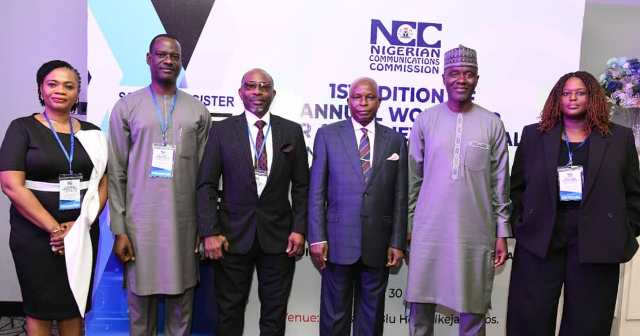
Emmanuel Ukudolo I Thursday, July 31, 2025
LAGOS, Nigeria – The three arms of government have been called upon to collaborate and cooperation to address issues affecting unimpeded operation of the telecommunications sector to engender improved regulation for enhanced economic development.
Attorney General of the Federation, Mr. Lateef Fagbemi, SAN and Chairman of the Nigerian Communications Commission, NCC, Dr. Aminu Maida made the call while speaking on the theme titled “ Building and driving synergy in regulating communications for digital transformation of Nigeria”, at a workshop for Attorneys General of State in Lagos.
Fagbemi alluded to challenges such as multiple taxation and levies imposed by federal, state and local authorities; wanton destruction of telecommunications infrastructure, especially in conflict-prone areas; regulatory overlaps that confuse operators and complicate compliance; slow broadband infrastructure roll-out which is due in part to right-of-way challenges and inconsistent state policies, among others.
We must be able to advise our respective governments on policies that affect the digital economy, ensure that our laws and enforcement actions are constitutionally sound and support dispute resolution mechanisms that prevent prolonged litigation. We must also work to champion data privacy, cyber security and digital rights enforcement at the State level
He also alluded to incidents which he described as rather unfortunate brought about by lack of cooperation and collaboration among governments such as we had in Ogun State, where the state imposed multiple taxation in 2024 which saw the temporary suspension of expansion projects as a result of overlapping local government levies, as well as vandalization of base stations in Kano in 2023.
“These incidents constitute economic sabotage, negatively impact the development of the communications sector and hinder digital transformation in the country”, he said. He equally made reference to what could be achieved where there is cooperation and collaboration as we had in Anambra state in 2023.
In that year, he said Anambra State proactively adopted a unified right-of-way policy, resulting in a 38% increase in fibre optic expansion within 6 months.
“Proactive measures like these are laudable and I encourage all stakeholders to support the developmental efforts of the Nigerian Communications Commission”, he said, pointing out that it is therefore critical that the three arms of Government, as stakeholders cooperate and collaborate to address these issues and ensure improved regulation of the communications sector for enhanced socio-economic development.
“The legislature must review and strengthen laws that protect infrastructure and support the communications sector, while the executive reinforce measures aimed at implementing these laws.
“The judiciary is also a key stakeholder in ensuring offenders and saboteurs are made to face the full wrath of the law”, Fagbemi said. The AGF noted that these measures are not only to be adopted at the Federal level but that the state governments must also play key roles.
“Through institutional and governmental cooperation, we can eliminate some of these challenges”, he noted.He equally called on stakeholders to work towards adopting strategies and mechanisms that enhance synergy in regulating communications for the digital transformation in Nigeria.
“These include legal and policy harmonization, creation of a Federal-State regulatory coordination forum, adopting uniform Right of Way (ROW) Policy Implementation, joint enforcement of laws that protect infrastructure and consolidation of digital taxation framework”, he said, stressing that Attorneys-General as Chief Law Officers under the constitution are uniquely placed to drive synergy.
”We must be able to advise our respective governments on policies that affect the digital economy, ensure that our laws and enforcement actions are constitutionally sound and support dispute resolution mechanisms that prevent prolonged litigation. We must also work to champion data privacy, cyber security and digital rights enforcement at the State level”, he advised.
He called on Attorneys-General to commit to working together with the Nigerian Communications Commission and relevant stakeholders to deliver on the vision of a transformed communications sector, for enhanced socio-economic development of Nigeria.
Earlier in his opening remarks, Chairman and Chief Executive Officer of the Nigerian Communications Commission, NCC, Dr. Aminu Maida said the theme of the workshop reflects the Commission’s belief that collaboration is not optional, but essential, adding “no sector, especially one as dynamic and impactful as communications, can be effectively regulated in isolation”.
He said the communications sector remains a vital enabler of innovation, commerce, governance, and inclusion, stressing that there is the need to tackle a wide range of challenges to fully unlock its potential.
“This is where your role, as Attorneys-General, becomes critical. You are not only the Chief Law Officers of your states; you are also policy influencers and key partners in shaping the legal frameworks that support national development. Your insights and guidance help ensure that innovation happens within a structure that promotes fairness, accountability, and long-term stability”, he said.
Going into memory lane, the NCC chairman said since the early 2000(s), communications regulation has evolved through distinct phases—from liberalising markets and establishing independent regulators, to expanding broadband infrastructure and fostering universal access. In the 2010(s), attention shifted to protecting consumers, enabling digital financial services, and addressing cross sectoral challenges.
“Today, regulators are focused on advanced frontiers such as AI governance, digital resilience, and sustainable connectivity. Throughout this journey, one constant remains: collaborative, forward looking regulation is essential to sustaining innovation and inclusive digital growth”, he said, noting that the workshop has been designed to address some of the most pressing issues in the sector today, including:
“A review of the Nigerian Communications Act (2003); Streamlining taxation in the communications sector; Addressing regulatory overlaps and protecting Critical National Information Infrastructure (CNII)”
He explained that following the 2024 Executive Order signed by President Bola Ahmed Tinubu, the designation of communications infrastructure as CNII gives us a new framework for collaboration with the Office of the National Security Adviser and other stakeholders.
“We must now operationalize it effectively”, he said adding that as Nigeria accelerates its digital transformation, underpinned by technologies such as AI, IoT, and high-speed connectivity, the challenges will grow more complex. But so too will the opportunities”, he said and that to succeed, Nigeria must adopt a Whole-of-Government approach that leverages the strengths of all institutions—federal and state.
He said the NCC is committed to working with all stakeholders to align regulatory actions with broader national goals. “We believe the Attorneys-General have a strategic role to play—not just in interpreting the law, but in shaping an enabling legal environment where technology and governance work in tandem”.