

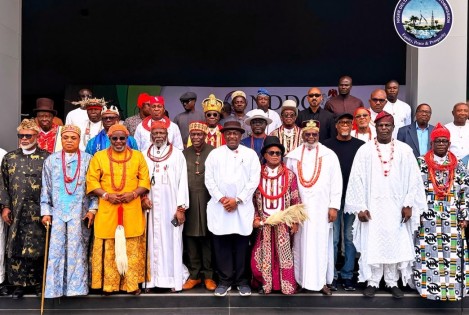
- The NDDC Director, Administration and Human Resources, Sir Kelechi Nwelue and the Director, Community and Rural Development, Engr. Theophilus Alagoa (middle), surrounded by traditional rulers and stakeholders, during the Stakeholders’ Forum on Public Infrastructure and Vandalism Prevention in Port Harcourt
By Emmanuel Thomas l Sunday, Sept 26, 2026
PORT HARCOURT — The Niger Delta Development Commission (NDDC) has issued an urgent call to traditional rulers, community leaders, and youth groups across the Niger Delta region, urging them to take collective ownership and remain vigilant in safeguarding public infrastructure against vandalism, theft, and deliberate destruction.
The charge was delivered during a crucial Stakeholders’ Forum on Public Infrastructure and Vandalism Prevention held in Port Harcourt, Rivers State. The event brought together key regional figures to address the persistent threat posed by infrastructure destruction to sustainable development in the Niger Delta.
Addressing the delegates, the Managing Director of the NDDC, Dr. Samuel Ogbuku, stressed that while the federal government and interventionist agencies bear the obligation to provide essential amenities, the ultimate responsibility for protecting these assets rests squarely on the host communities.
Represented by the Director of Administration and Human Resources, Sir Kelechi Nwelue, Ogbuku warned that the destruction of public property inflicts direct harm on community members rather than government institutions.
“The aim of the government is to focus on infrastructure, but after building, how do we protect it?” Ogbuku asked.
“Where public infrastructure is vandalized, money meant for new projects is diverted to repair what has been built, thus limiting infrastructure progress. Security is an important factor in society. Development strengthens security, and security protects development.”
The NDDC boss implored community leaders and residents to shift their mindsets, urging them to view public amenities—such as roads, bridges, power installations, pipe-borne water schemes, schools, and health facilities—not as remote government property, but as shared community assets.

“There is a need to create awareness and educate citizens that projects executed by the government are the property of the community, and they should protect it,” Ogbuku added. “We should move to building a culture where vandalism becomes socially unacceptable.”
He appealed to traditional institutions, youth groups, and resident associations to build robust community-level vigilance networks and promptly report suspicious activities around public installations to security authorities.
Corroborating the Managing Director’s remarks, the NDDC Director of Community and Rural Development, Engr. Theophilus Alagoa, decried the growing trend of facility destruction where no local entity assumes responsibility.
Alagoa cautioned that vandalism, theft, and economic sabotage carry severe social and legal consequences. He noted that destroying development infrastructure destabilizes essential public service delivery and wastes limited economic resources.
“This event was organized to inform and educate everyone that government projects are our property and it is imperative to take care of the investment,” Alagoa stated.
“Vandalizing, destroying, or stealing government projects is a serious crime and an act of economic sabotage. Such acts not only result in the loss of valuable public resources but also undermine the delivery of essential services and increase the cost of maintaining and replacing infrastructure.”
In his remarks, the facilitator of the forum, Mr. Ibiyekaribo Inko-Tariah, called on participants to collaborate on actionable strategies to curb facility destruction.
He affirmed that the initiative forms part of a broader, sustained campaign by the NDDC to safeguard government-funded interventions and ensure that critical facilities continue to improve lives across the Niger Delta region.
