

By SCM International Desk I Monday, Sept 21, 2026
TEHRAN — Iran’s powerful Islamic Revolutionary Guard Corps (IRGC) delivered a blunt warning on Monday, asserting that Tehran is prepared to significantly expand the geographic footprint of the ongoing conflict in the Middle East and deploy a new generation of unseen weaponry.
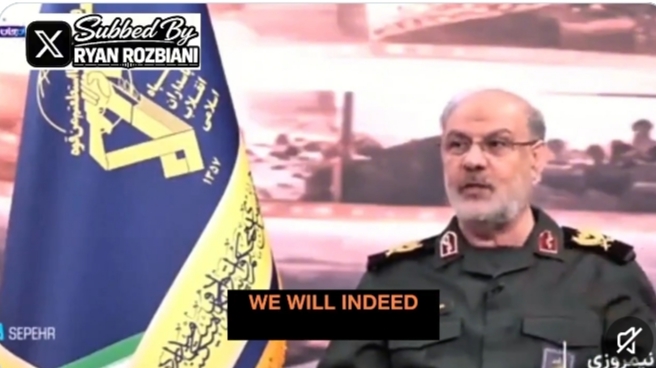
Speaking to regional news outlets, IRGC spokesman Brigadier General Hossein Mohebbi declared that Iran’s military posture was shifting toward a broader operational scope, warning that the armed forces were ready to execute attacks far beyond current battle zones.
“There is still room to expand this war,” General Mohebbi stated, according to Iranian state-affiliated media. “If a new aggression occurs, we will certainly change the weaponry and the geography of the war.”
He added that Iran’s military command had finalized preparations to integrate advanced technological assets into active combat. “We will introduce new weapons with new capabilities into the battle, and the world will be astonished,” General Mohebbi said, claiming that future strikes would target strategic objectives that have never been hit in previous engagements.

The explicit threat of geographic expansion and novel hardware underscores a significant escalation in Tehran’s strategic communications amid lingering regional confrontation.
While the spokesman did not detail the specific technical nature of the new systems, western analysts suggest the threat could refer to longer-range hypersonic ballistic missiles, swarming uncrewed aerial vehicles (UAVs) equipped with electronic warfare counter-measures, or advanced anti-ship capabilities capable of threatening international sea lanes.
General Mohebbi’s remarks arrive during a delicate geopolitical juncture, marked by persistent hostilities between Iranian-backed forces and a U.S.-led coalition defending international shipping corridors and regional infrastructure.
Over the past year, regional warfare has drawn in a network of Iran-aligned proxy groups—commonly referred to by Tehran as the “Axis of Resistance”—spanning Yemen, Iraq, Syria, and Lebanon. While direct strikes between Washington, Israel, and Iran have previously been calibrated to avoid an all-out regional catastrophe, Tehran’s latest declaration signals a potential abandonment of former rules of engagement.
Iran’s domestic defense sector, long constrained by international sanctions, has increasingly relied on indigenous missile development, low-cost drone technology, and asymmetric naval warfare strategies. By publicly threatening to unveil previously undisclosed assets, Tehran is attempting to bolster its deterrence framework against potential strikes on its nuclear infrastructure, oil export terminals, or command networks.
Diplomats and military observers view the IRGC’s posture as a dual message: a signal to internal domestic audiences that the defense establishment remains capable, and a sharp warning to Washington, Jerusalem, and Gulf neighbors that any renewed military pressure could spill over into wider Persian Gulf and Red Sea shipping channels. U.S. Defense Department officials have repeatedly stated that coalition forces remain at heightened readiness across the region, monitoring launch sites and naval movements for any sign of operational shifts.
