

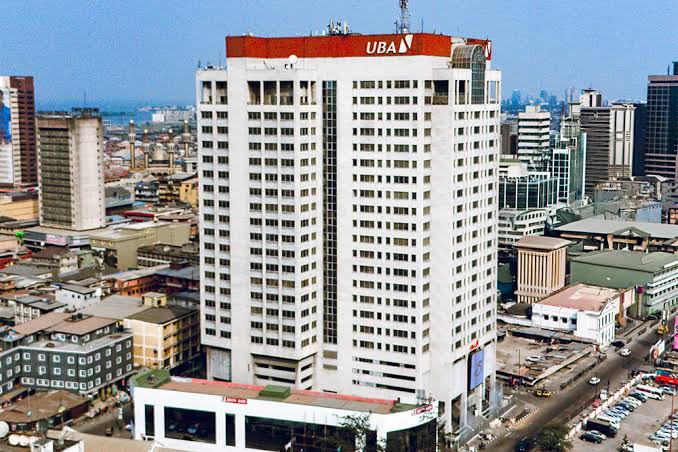
Scheduled for arraignment:
- UBA Plc
- Muyiwa Akinyemi
- Amangbo Eziashi Stephen
- Gesos Global Service Limited
- Fedat Global Limited
By Our Judiciary Correspondents
LAGOS, Nigeria — It is a scene that has become altogether too familiar in Nigeria’s Sisyphean campaign against institutional corruption: a packed courtroom, a frustrated prosecutor, an exasperated judge, and an empty dock without the main suspect, UBA Plc and its officials.
On Wednesday, inside the Criminal Division of the High Court of Lagos State in Ikeja, justice was once again put on hold.
The scheduled arraignment of United Bank for Africa Plc (UBA)—one of the continent’s ultimate financial titans—alongside two of its senior executives and two shell companies, collapsed into farce. The reason? The defendants simply did not show up.
The Economic and Financial Crimes Commission (EFCC), Nigeria’s premier anti-graft agency, had brought a damning four-count charge against UBA, senior officials Muyiwa Akinyemi and Amangbo Eziashi Stephen, as well as two corporate entities, Gesos Global Service Limited and Fedat Global Limited.
The allegations are staggering: foreign exchange infractions, concealment of criminal proceeds, stealing, and money laundering totaling a whopping N4.29 billion (approximately several million dollars in volatile parallel-market rates).
Yet, when Justice Rahman Oshodi called the case, the defense dock remained completely vacant. It was a glaring visual metaphor for the state of corporate accountability in Africa’s most populous nation—a place where billions evaporate, but the billionaires responsible are nowhere to be found.
The prosecution, led by EFCC counsel Temitope Banjo, did not mince words. He openly characterized the defendants’ absence as a deliberate, cynical ploy to “frustrate the trial.” According to Banjo, the disappearing act began long before Wednesday.
The two senior banking officials, Akinyemi and Stephen, had already jumped the administrative bail previously granted to them by the EFCC. They are, for all practical purposes, fugitives from the very regulatory system that supposedly governs them.
The defense, however, deployed a classic and exhausting playbook: the claim of ignorance. Adewale Kamourudeen, appearing “under protest” for the bank and its missing executives, argued with a straight face that his clients had never been served with the court processes.
”We got wind of it through newspaper reports,” Kamourudeen told the court, claiming complete innocence of the official charges. “That is why we are here.”
It was a defense that quickly crumbled under scrutiny. Banjo countered that the EFCC had indeed served the court papers directly to UBA’s Compliance Officer, Chima Okugbo, who had historically represented the bank and these exact individuals during the investigation.

When Justice Oshodi offered Kamourudeen the opportunity to accept the papers right there in the courtroom to expedite the trial, the defense lawyer flatly refused, citing a lack of “instructions.”
This is the choreography of Nigerian high-finance litigation. It is an intricate dance of technicalities, bureaucratic evasion, and manufactured ignorance designed to kick the can down the road until public interest wanes and memories fade.
To understand why UBA and its executives are fighting so hard to avoid the dock, one must look at the gravity of the charges. The EFCC alleges that between September 2022 and March 2023, the defendants actively conspired to sell foreign exchange at rates far above those stipulated by the Central Bank of Nigeria (CBN).
In a country currently suffocating under a severe foreign exchange crisis—where everyday citizens watch their purchasing power disintegrate and legitimate businesses collapse due to dollar scarcity—the allegations paint a picture of gross institutional betrayal.
While the public was told to tighten its belt, one of the nation’s largest financial institutions was allegedly operating an underground premium market, funneling N4.29 billion in illicit profits into a hidden internal account.
Count Three of the charge explicitly accuses UBA of retaining these proceeds of crime, a direct violation of the EFCC Establishment Act of 2004. This was not a back-alley operation; it allegedly occurred within the core infrastructure of a bank trusted by millions.
The UBA scandal cuts to the heart of Nigeria’s ongoing struggle with economic stability. When Western investors look at Nigeria, their primary anxiety is not a lack of opportunity, but the total unpredictability of law enforcement and corporate governance.
When a tier-one bank can allegedly violate central bank directives, hide billions, and then allow its executives to skip bail without immediate, severe institutional consequences, the entire financial system loses credibility.
By adjourning the matter to June 16, 2026, for a “report on service,” Justice Oshodi did what the law requires, but the delay represents a minor victory for the defense.
Every week this trial is delayed is another week UBA operates with its reputation shielded from a formal plea.
The EFCC must now decide how aggressively it wishes to pursue this case. If the agency allows UBA and its executives to turn this trial into a multi-year circus of technical delays, it will send a clear message to the financial sector:
if you steal enough, the court becomes optional. For now, the N4.29 billion sits in a bank ledger, the executives remain missing, and justice waits outside the courtroom doors.
UBA
