

By SCM ONLINE REPORTER
IRAN has issued a chilling warning to the West, claiming it has the “lawful” right to shut down the Strait of Hormuz—the world’s most vital oil artery.
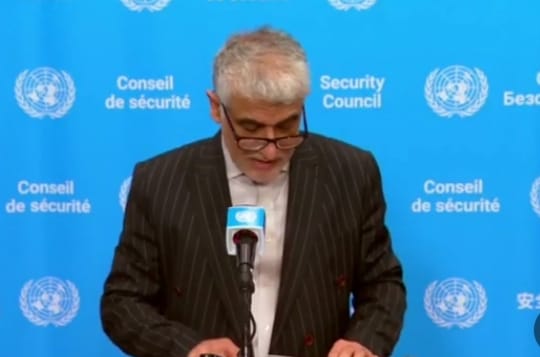
In a defiant stand at the UN Security Council, Tehran’s top diplomat insisted that the Islamic Republic is not bound by international sea treaties and blamed the US for “illegal” interference in the region.
The explosive comments from Ambassador Amir Saeid Iravani have sent shockwaves through global markets, raising fears of a massive spike in petrol prices and a potential military “flashpoint” in the Middle East.
‘Not Our Rules’
Speaking to world leaders, Iravani argued that because Iran never signed the 1982 UN Convention on the Law of the Sea (UNCLOS), it doesn’t have to play by the rules that govern most of the world’s oceans.
Instead, he claimed Iran’s actions in the narrow waterway—where a third of the world’s liquefied natural gas and 25% of total global oil consumption passes—are governed only by its own national laws.
”Iran’s measures taken in the Strait of Hormuz are lawful actions grounded in its national laws and regulations,” Iravani told the council.

In a classic “blame-the-West” maneuver, the Ambassador warned that if maritime traffic is disrupted or ships are seized, it’s the fault of the United States and the UK.
He slammed Western sanctions and naval presence in the region as an “illegal blockade,” adding:
The Threat: Any disruption to shipping is the “responsibility of the US and its allies.”
The Defiance: Iran will only follow “customary international law,” ignoring specific treaty obligations.
The World’s Deadliest Choke Point
The Strait of Hormuz is a narrow stretch of water—only 21 miles wide at its narrowest point—separating Iran and Oman. It is the only way to move oil from the Persian Gulf to the open ocean.
Global Impact: If the Strait is closed, the world economy could face a “heart attack,” with oil prices predicted to soar past $150 a barrel.
The Tension: For years, Iran’s Revolutionary Guard (IRGC) has used fast boats to harass Western tankers and has even seized vessels, including the British-flagged Stena Impero in 2019.
The Legal Loophole: While most nations follow UNCLOS to ensure “innocent passage” for ships, Iran’s refusal to ratify the treaty allows them to argue they have more control over who enters their territorial waters.
The US Fifth Fleet, based in Bahrain, has vowed to keep the shipping lanes open, setting the stage for a high-stakes showdown on the high seas.
