

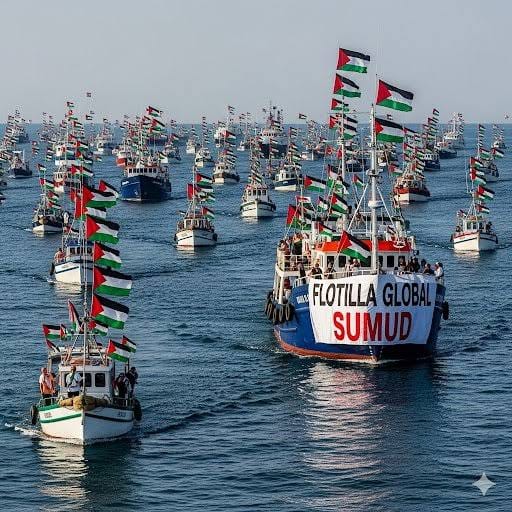
By SCM Correspondent
THE HAGUE — A prominent coalition of international human rights lawyers and legal experts has formally petitioned the International Criminal Court (ICC) to expand its ongoing war crimes investigation in Palestine to encompass Israel’s recent high-seas military interception of a humanitarian aid convoy.
The comprehensive legal submission, filed on May 29, demands an immediate international inquiry into the treatment of hundreds of civilian activists who were captured by Israeli naval forces in international waters.
The incident has reignited fierce global debates over the legality of Israel’s maritime blockade of the Gaza Strip and the limits of military enforcement in neutral waters.
The legal filing centers on the dramatic events of mid-May, when the Israeli Navy launched a coordinated operation to block the “Global Sumud Flotilla.” Comprising multiple vessels carrying humanitarian supplies, the flotilla was staffed by 428 civil society activists, medical professionals, and human rights defenders representing 44 different nationalities.
Organizers and legal representatives state that the convoy was heavily intercepted while sailing through international waters—well outside Israel’s territorial jurisdiction—near Cyprus.
According to the petition, Israeli forces deployed electronic jamming to sever the ships’ emergency and satellite communications before forcefully boarding the vessels.
The submission presented to the ICC prosecutors in The Hague contains detailed survivor testimonies, independent medical evaluations, and sworn legal affidavits collected from the participants following their subsequent detention and deportation by Israel.
The documents allege widespread human rights violations, including unlawful detention in international waters, physical assaults, systemic mistreatment, and instances of sexual violence while in the custody of the Israeli Prison Service.

Israeli authorities have firmly rejected the allegations of abuse. A spokesperson for the Israeli Foreign Ministry maintained that the operation was a lawful enforcement of its ongoing naval blockade of the Gaza Strip, asserting that the detained activists were treated with “great sensitivity” and that the military acted to prevent an unauthorized breach of its security perimeter.
The clash over the Global Sumud Flotilla represents the latest and largest escalation in a long-standing history of civilian-led maritime challenges to Israel’s blockade of Gaza, which was first imposed in 2007.
The legal dynamics heavily echo the infamous 2010 Mavi Marmara incident, when an Israeli raid on a similar Turkish-led aid flotilla resulted in the deaths of ten humanitarian activists and sparked a profound international diplomatic crisis.
While previous legal challenges struggled to find traction due to complex jurisdictional hurdles, the current petition is strategically designed to latch onto an existing, active judicial framework.
The ICC opened a formal investigation into alleged war crimes committed in the Palestinian territories in 2021. Because the court’s mandate covers crimes committed on the territory of Palestine or by its nationals, as well as actions directly tied to the ongoing conflict, the petitioning lawyers argue that the treatment of international aid volunteers is inextricably linked to the broader, systemic violations currently being scrutinized by the global court.
The filing places additional political and legal pressure on ICC Chief Prosecutor Karim Khan, whose office has faced intensifying scrutiny from both Western nations and Global South coalitions over the pace and scope of the Palestine probe.
Legal analysts suggest that because the 428 activists originate from dozens of countries—many of which are state parties to the Rome Statute that governs the ICC—the case could compel domestic governments to take a more aggressive stance regarding the legal protection of their citizens when intercepted by foreign judiciaries.
”Our people were beaten, and they suffered severe trauma in international waters where they should have been protected by maritime law,” said a legal representative associated with the filing, speaking on condition of anonymity due to the sensitivities of the ongoing litigation.
“If international legal institutions fail to investigate a military assault on a peaceful civilian fleet from 44 nations, it signals an entirely lawless precedent for the high seas.”
