


By BLAISE UDUNZE | Monday, Oct. 05, 2026
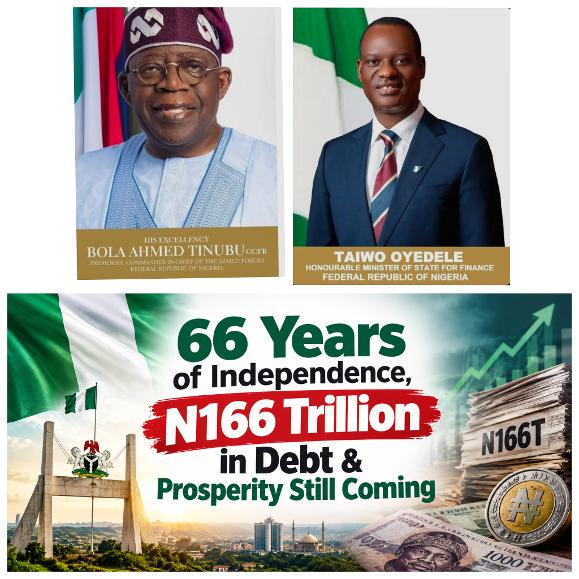
LAGOS, Nigeria — Sixty-six years is not just 66 days; it represents 24,105 days—more than six decades since Nigeria hoisted its flag as an independent nation. Yet, the country now faces a troubling contradiction. While government officials tout economic reforms and a brighter future, the federal government is negotiating another $1.5 billion in World Bank loans, even as national public debt reaches an unprecedented N166.79 trillion.
However, borrowing must serve a purpose beyond keeping government expenditure afloat. It must yield measurable economic returns, improve living conditions, and strengthen the country’s capacity to repay. Otherwise, the nation risks falling into a debt trap where every new loan creates a fresh repayment obligation without expanding the productive capacity required to service it. This is where Nigeria’s debt strategy demands rigorous scrutiny


These figures continue to disquiet millions of Nigerians struggling with soaring food prices, transportation costs, unemployment, school fees, healthcare expenses, and the relentless pressure of daily survival. The question is no longer whether Nigeria is independent, but whether that independence has delivered the economic freedom and prosperity its citizens were promised.
The irony is difficult to ignore. On October 1, 2026, Nigeria marked its 66th Independence anniversary under the theme of moving “from reforms to prosperity”—a narrative that starkly contrasts with the people’s lived experiences. In his address, President Bola Tinubu declared that the nation had corrected its economic course and was positioned to translate reforms into shared prosperity.
Yet, barely days before the celebration, reports emerged that the Federal Government was negotiating three proposed World Bank financing facilities worth $1.5 billion—comprising $500 million each for climate resilience, social protection, and early childhood development.There is nothing inherently wrong with borrowing.
Developing nations—provided they are productive—borrow to build infrastructure, expand capacity, strengthen social safety nets, and fund long-term development. Nigeria cannot realistically fund all its infrastructure and development needs from current revenues alone; structured borrowing remains a legitimate fiscal tool.
However, borrowing must serve a purpose beyond keeping government expenditure afloat. It must yield measurable economic returns, improve living conditions, and strengthen the country’s capacity to repay. Otherwise, the nation risks falling into a debt trap where every new loan creates a fresh repayment obligation without expanding the productive capacity required to service it. This is where Nigeria’s debt strategy demands rigorous scrutiny.
According to the Debt Management Office (DMO), Nigeria’s total public debt stood at N166.79 trillion ($120.93 billion) as of June 30, 2026. Domestic debt accounted for N91.59 trillion (54.91 percent), while external debt stood at N75.20 trillion (45.09 percent). The Federal Government accounted for N152.77 trillion of this total, with the states and the Federal Capital Territory carrying the remaining N14.01 trillion.
Even more concerning is the velocity of this accumulation. Public debt surged by N7.44 trillion between March and June 2026 alone—a 4.7 percent quarterly increase. Year-on-year, the debt stock expanded by N14.39 trillion compared to June 2025.
These statistics are not abstract accounting entries. They represent real obligations that must ultimately be settled through public revenue, refinancing, or structural adjustments.
They also highlight a fundamental mismatch between the government’s appetite for borrowing and its capacity to generate the revenue required to service accumulated debt without sacrificing vital capital projects.
The most unsettling aspect of this trajectory is that public debt continues to mount while ordinary citizens face severe economic hardship. In June 2026, the International Monetary Fund reported that poverty had risen to 63 percent based on Nigeria’s national poverty line. By late 2025, 27 million Nigerians were experiencing acute food insecurity.
Behind these numbers are real human stories: families cutting back on meals, parents struggling to pay tuition, small business owners overwhelmed by operating costs, graduates searching for work, and wage earners watching their purchasing power erode.
For ordinary citizens, economic progress cannot be measured by abstract indicators like GDP growth, foreign reserve levels, or approvals from multilateral lenders. True prosperity must be felt in the marketplace, at the fuel pump, in classrooms, in hospitals, and in a household’s ability to meet basic needs without falling into financial distress.
This is not to dismiss macroeconomic stabilization efforts acknowledged by global institutions. The World Bank notes progress in stabilizing key macro metrics, but stresses that household incomes have not recovered and poverty remains widespread. The central challenge remains converting macroeconomic stability into tangible improvements in daily life—and that requires accountability.
Before committing the country to additional debt, the government owes citizens a comprehensive accounting of previous loans: which projects were financed, which have been completed, what benefits were delivered, what liabilities remain, and how these investments have boosted overall productivity.
While the DMO publishes regular updates and borrowing undergoes formal budgetary processes, aggregate figures do not satisfy the need for development transparency. Citizens need clear line-of-sight connecting borrowed funds to completed projects, verified outcomes, and debt servicing obligations. Announcing new loan approvals can no longer substitute for proving the impact of past borrowing.
If billions have been borrowed for infrastructure, the public should be able to inspect completed works and evaluate their economic impact. If loans were intended for social safety nets, the government should disclose how many vulnerable households benefited and whether their conditions permanently improved. If funds were directed to agriculture or manufacturing, the resulting productivity and employment gains should be clearly measurable.
This is not an argument against borrowing; it is a call for borrowing with accountability.
The proposed $1.5 billion World Bank facilities target vital areas: climate resilience, social safety nets, and early childhood development. While these are noble development priorities, their approval and implementation must be guided by transparent financing terms, clear benchmarks, defined timelines, and independently verifiable results.
Furthermore, the government must confront the fiscal trade-offs of its borrowing strategy.
Heavy domestic borrowing crowds out private sector credit. Foreign currency debt exposes the nation to exchange rate volatility. Crucially, debt service costs siphon away revenue that should fund healthcare, education, and basic infrastructure.
The ultimate danger is a compounding cycle: borrowing for development, then borrowing again to service existing debt. Such a loop places immense pressure on taxpayers and future administrations, especially if revenue growth fails to match debt obligations.
The solution is not to reject foreign capital or abandon development financing entirely. Rather, it is to enforce a disciplined framework where every proposed loan demonstrates strict economic justification, clear repayment plans, execution capacity, and measurable social returns.
The National Assembly must exercise rigorous oversight over loan proposals and fund deployment. The DMO should deepen public disclosure regarding repayment schedules. Ministries, departments, and agencies managing loan-funded projects must publish regular progress reports. Finally, independent audits must verify whether funds reached their intended targets and generated expected returns.
Above all, the Federal Government must accelerate domestic revenue mobilization, enforce fiscal discipline, and prioritize investments that expand productive capacity over those that deepen debt dependence.
Nigeria’s 66th Independence anniversary should serve as a moment to bridge the gap between founding promises and contemporary realities. Independence was never meant to be a mere shift in political governance; it carried a pledge of dignity, economic self-determination, and opportunity for future generations. That promise becomes harder to defend when public debt climbs while millions remain trapped in poverty.
Celebrations of policy reforms and international investor confidence must yield to the ultimate test of economic management: whether ordinary citizens are experiencing real, measurable improvements in their quality of life.
At 66, Nigeria must move beyond demonstrating its capacity to borrow; it must demonstrate its capacity to build. The nation cannot afford a future where every Independence Day brings another loan announcement and another promise that prosperity is around the corner. Borrowing must be tied to a clear, productive strategy that yields tangible results.
The question facing the nation is larger than a single $1.5 billion loan or a N166.79 trillion debt stock. It is whether Nigeria can convert borrowed capital into enduring growth before the cost of financing its ambitions overwhelms the very economy it seeks to build.
Nigerians deserve more than promises and anniversaries. They deserve an audit of past loans, evidence of completed projects, and a credible plan ensuring that the next generation inherits a prosperous economy rather than a bill for unfulfilled potential.
Blaise, a journalist and PR professional, writes from Lagos and can be reached via: blaise.udunze@gmail.com